
Introduction: Markets Looking Up
Although headlines are full of short-term gloomy news on markets, we wanted to shed some light on the year-to-date performance of both equity & bond markets. As of Monday morning, the S&P 500 is up more than 6% year-to-date, and the majority of bond funds are up more than 2%. There are two primary drivers for this at the moment:
- Inflation is coming down; the Federal Reserve is acknowledging this in its recent commentary (this is supporting both bond and equity markets through lower revised interest rate expectations).
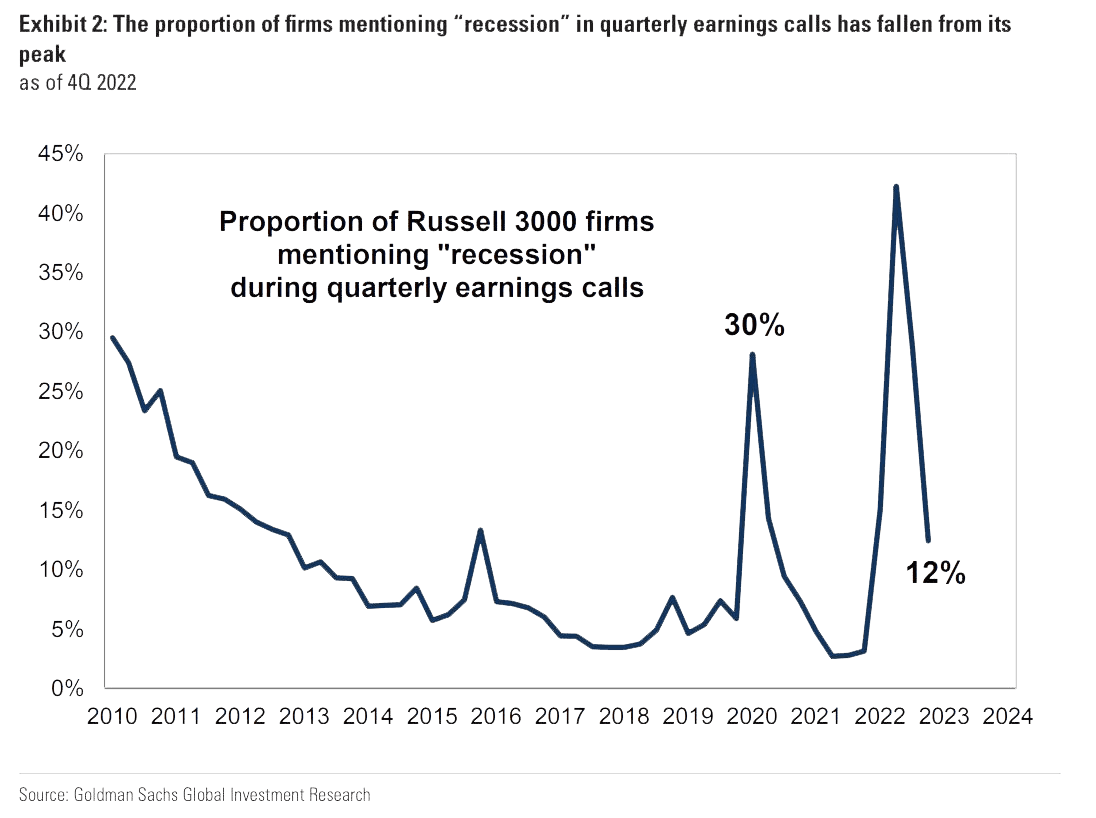
- The worrying expectations of a recession are now slowly dissipating. Economic data is still appearing very positive: the unemployment rate is the lowest it’s been in the US in more than 40 years, most forecasts predict that the S&P 500 will have positive growth in operating earnings for 2023 & 2024, and even the mention of the word “recession” during quarterly earnings calls has dropped dramatically:
Conclusion: Markets Looking Up
All this is excellent news for both bond and equity markets. The inflation data provides relief around further, more aggressive interest rate hikes (above what is already expected). Also, the positive economic data creates an environment where businesses can remain healthy through increased earnings.
In addition to the positive news, the federal reserve has also returned to the point of strength with its high benchmark interest rate, which it can reduce in the future should we face adverse market conditions.
Frequently asked questions
Does YTD performance predict the rest of the year?
Not reliably. Markets that have rallied early in the year aren't predictably worse for the second half; markets that have struggled aren't predictably better. The relationship between YTD performance and remaining-year performance is much weaker than commentary often suggests.How should I use market commentary?
For context, not for action. Understanding what drove a period's performance helps you evaluate whether your portfolio captured it (and whether it should have). Acting reactively on YTD numbers — chasing winners or fleeing losers — typically destroys value rather than creating it.When should I rebalance?
When allocations drift outside pre-set bands, not based on YTD numbers. If your target allocation is 60% equity / 40% fixed-income and equities have rallied to 70%, rebalance back to target — not because of YTD performance specifically, but because the allocation has drifted.
Related reading
More on Markets & macro
- NewsletterWhat 2025’s Market Turbulence Is Teaching InvestorsResearch shows that investor behaviour — staying invested, rebalancing, avoiding reactive decisions — has more impact on outcomes than any single market call.
- NewsletterGold’s Surge and What It Could Mean for InvestorsGold prices are soaring to record highs, but is the rally sustainable? Explore what’s driving demand, the risks ahead, and gold’s role in a modern portfolio.
- NewsletterIs the AI Boom a Bubble, or Just the Beginning?AI valuations are soaring — but is it sustainable? Discover what's fuelling the hype, where risks lie, and how MENA investors can stay exposed and protected.