
Investing in Bonds: The Dilemma
Since the rate rises of 2022, high-quality bonds have offered yields that cash holders had not seen for over a decade, and locking in a known income for several years is understandably attractive.
The practical question is how to own them. You can buy single-name bonds, lending directly to one government or company until a fixed date, or you can buy a bond fund, which pools many bonds under a manager. They behave differently in ways that matter for income, risk and cost.
Single-name bonds vs bond funds: side by side
| Single-name bonds | Bond funds (mutual funds and ETFs) | |
|---|---|---|
| Maturity | Fixed date; principal returned if the issuer pays | None; the fund keeps rolling into new bonds |
| Income | Known coupons in advance | Varies as holdings change |
| Interest-rate risk | Falls as the bond approaches maturity | Roughly constant, set by the fund’s target duration |
| Reinvestment | You decide what to do with coupons and maturities | Handled automatically |
| Issuer diversification | Only as many issuers as you can afford | Typically hundreds of issuers |
| Typical minimum | Often USD 200,000 per bond for US dollar issues | Price of one unit or share |
| Liquidity | Dealer market; small lots can trade at wider spreads | Daily dealing; ETFs trade intraday |
| Costs | Dealer spread when buying and selling; no ongoing fee | Ongoing fund fee plus trading inside the fund |
| Best suited to | Known future spending; larger allocations; high-quality issuers | Smaller allocations; high-yield and emerging-market credit; hands-off income |
Duration: the “hold to maturity” argument
The most common case for single bonds is that you can ignore price falls by holding to maturity. It is partly true. A bond’s market value falls when rates rise, whether you hold it directly or through a fund. Holding directly does not avoid that loss in economic terms; it hides it, because the bond still returns its face value at maturity if the issuer pays.
What does differ is the path. A single bond’s sensitivity to interest rates, its duration, shrinks every year as maturity approaches. A fund that targets, say, a five-year duration keeps that sensitivity indefinitely. As an illustration, if rates rise by one percentage point, a portfolio with a five-year duration falls by roughly 5% in price. The fund then reinvests maturing bonds at higher yields, so its income rises over time. Our fixed income deep dive on price sensitivity explains the mechanics.
For an investor with a bill to pay in 2030, a bond maturing in 2030 matches that liability precisely. A fund cannot promise what it will be worth on any given date.
Reinvestment and minimum sizes
Single bonds pay coupons in cash, usually twice a year, and return principal at maturity. You then have to decide where that money goes, at whatever yields are available at the time. That is reinvestment risk, and it is the price of control. A fund reinvests automatically.
Size is the larger constraint. Bonds issued into international markets are frequently sold in large minimum denominations. Under the EU Prospectus Regulation, offers with a denomination of at least EUR 100,000 per unit are exempt from the requirement to publish a retail prospectus, and US dollar issues commonly follow with USD 200,000 minimums. Gulf issuers are no exception: Banque Saudi Fransi’s 2025 US dollar Tier 2 notes, for example, carried a minimum subscription of USD 200,000.
The arithmetic is unforgiving (illustrative): an investor with USD 1 million for bonds and USD 200,000 lots can own five issuers at most, each a fifth of the allocation. Owning twenty issuers needs around USD 4 million.
Bonds and Diversification: An Example
To make the issuer risk concrete, consider two hypothetical brothers, Alex and Noah, both investing in 2006.
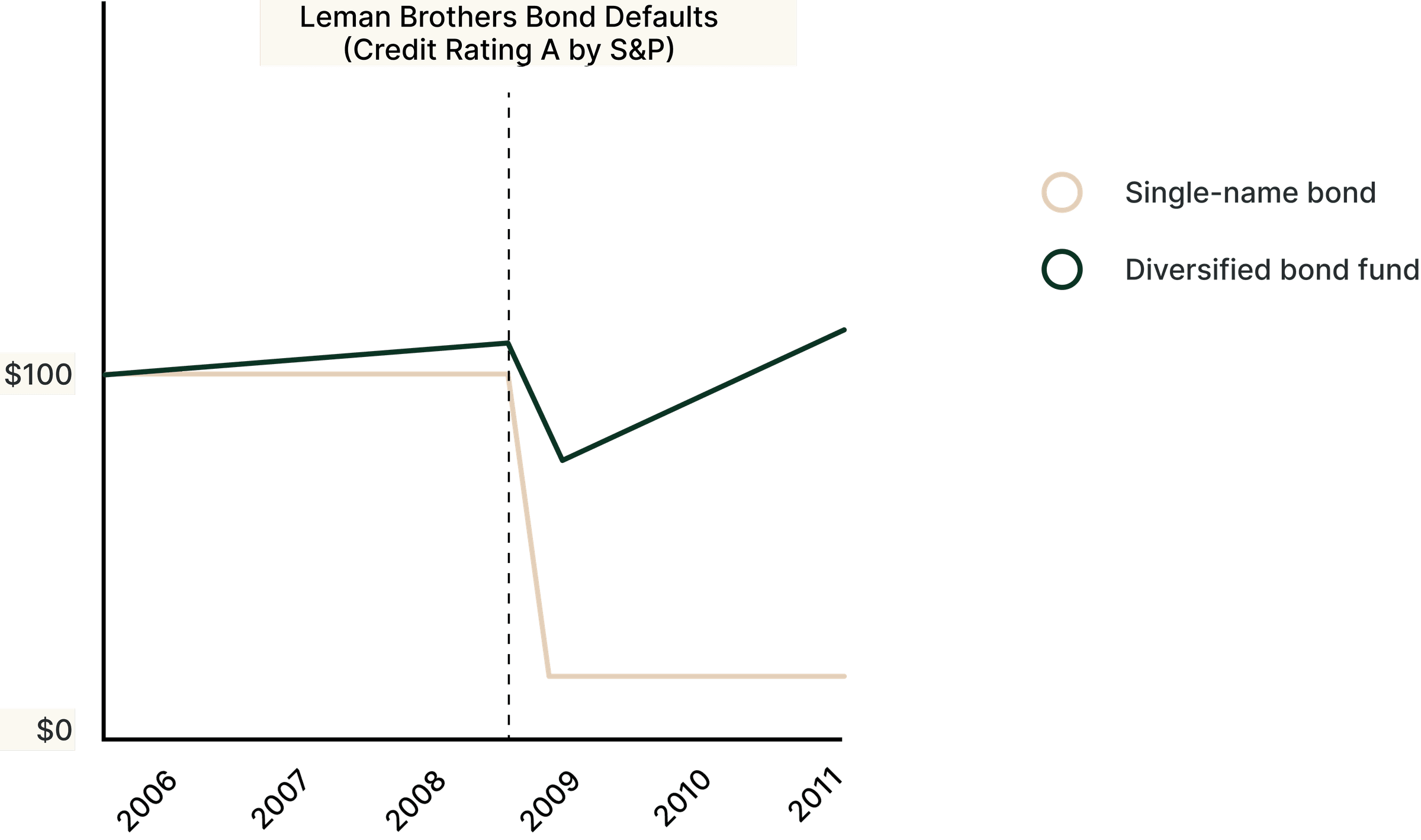
Alex, 50, had saved carefully throughout his career and preferred fixed returns. He put his savings into a single five-year bond issued by Lehman Brothers, then one of the most respected names on Wall Street. Noah preferred diversification and bought an investment-grade bond fund holding bonds from hundreds of issuers.
In September 2008, Lehman Brothers filed for bankruptcy. Its credit was not considered weak: in June 2008, three months before the filing, Moody’s still rated the holding company’s senior debt A1, at the top of the single-A band, while placing it on review for downgrade. Senior bondholders recovered only a fraction of face value, paid out through bankruptcy distributions that continued until 2021. Alex suffered a large, permanent loss and waited more than a decade to learn how large.
Noah’s fund also fell during the crisis, and it may well have held some Lehman debt. But in a fund holding hundreds of issuers, a single default is a small dent (illustratively, a 0.5% position written off costs 0.5% of the fund), and the rest of the portfolio kept paying. Most of his fall was temporary repricing rather than permanent loss.
A few notes to add:
- A strong rating describes a low probability of default, not zero. Concentration turns a low-probability event into an all-or-nothing outcome.
- Had Alex placed the same money in a deposit with a Lehman entity, he would still have been exposed to its failure. Deposits above any insured limit and bonds are both claims on the institution’s balance sheet.
Liquidity and costs
Most bonds trade over the counter through dealers rather than on an exchange. Buying or selling a small lot of a corporate bond can mean a noticeably wider spread than an institution would pay, and selling before maturity in a stressed market may mean accepting a poor price. That cost is paid once, on the way in and the way out.
A fund’s costs are ongoing: an annual management fee plus the fund’s own trading. In return you get daily dealing and professional credit research. For a buy-and-hold ladder of high-quality bonds, single names are often cheaper over the full term; for an allocation that will be traded or topped up often, funds usually are.
When each fits
Single-name bonds tend to suit investors who have:
- known future outflows to match, such as school fees, a property purchase or a planned exit from the UAE;
- a fixed-income allocation large enough to hold many issuers;
- a preference for high-quality government and investment-grade issuers.
Bond funds tend to suit investors who:
- have smaller allocations or want to add money regularly;
- want exposure to high-yield or emerging-market credit, where diversification matters most;
- value liquidity and do not need a fixed end value on a specific date.
Many portfolios use both: a diversified fund as the core of the bond allocation, plus a short ladder of high-quality bonds or sukuk matched to spending over the next few years. For investors who need Shariah-compliant income, our framework on whether sukuk are the same as bonds covers the structural differences. Defined-maturity bond ETFs, which hold a diversified basket that matures in a single year, sit between the two.
The UAE angle
Two local features shape the choice. Because the dirham is pegged to the US dollar, US dollar bonds carry little currency risk for spending in AED, which makes laddering dollar bonds against UAE liabilities straightforward. And the UAE levies no personal income tax on individuals’ coupons or gains, so the tax differences that drive the choice in many countries largely fall away here, unless your nationality keeps you taxable at home. Fund domicile still matters, since it affects withholding tax on income and, for US-domiciled funds held by non-US persons, potential US estate tax exposure.
Conclusion: Moral of The Story
Single-name bonds offer certainty of cash flow; bond funds offer certainty of diversification. Choosing between them is a question of size, purpose and how much issuer risk you can afford to concentrate. A robust financial plan identifies which liabilities need matching and which money can simply be invested, and a diversified portfolio does the rest. Like a sturdy ship, a well-constructed plan can navigate unexpected rough water and still reach its destination.
Frequently asked questions
What's the main difference between single bonds and bond funds?
Defined vs undefined maturity. A single bond matures on a known date with a known principal payment. A bond fund holds many bonds and keeps replacing those that mature, so the fund itself has no maturity and its price moves with interest rates indefinitely. Both have legitimate uses, but they solve different problems.Are individual bonds safer than bond funds when interest rates rise?
Not in economic terms. A bond you hold falls in market value when rates rise, exactly as a fund does; you simply do not see the price if you hold to maturity. The real difference is certainty of the end value: a single bond returns its face value at maturity if the issuer pays, while a fund has no date at which its value is fixed. In exchange, a fund reinvests at the new, higher yields as its holdings roll over.When should I use single-name bonds?
Three situations. (1) Specific future cash needs, such as school fees, a property purchase or retirement income, that you want to match to known maturity dates. (2) Larger fixed-income allocations, where you can hold enough issuers to diversify. (3) High-quality issuers, such as governments and strong investment-grade companies, where the diversification benefit of a fund matters less.When should I use bond funds?
Two situations. (1) Smaller allocations, where minimum lot sizes would leave you concentrated in a handful of issuers. (2) Lower-quality or specialist credit, such as high-yield and emerging-market debt, where spreading default risk across hundreds of issuers materially reduces the damage any single failure can do.How much do I need to build a bond ladder?
It depends on lot sizes and how many issuers you want. Many US dollar bonds and sukuk are sold in minimum denominations of USD 200,000. As an illustration, a ten-rung ladder with two issuers per rung at that size needs about USD 4 million. Below that, a fund or a defined-maturity bond ETF usually gives better diversification.What's a bond ladder?
A set of bonds with staggered maturities, for example equal amounts maturing every year for ten years. As each bond matures, the proceeds either meet a planned cash need or are reinvested at the long end. The structure gives predictable cash flow and avoids betting everything on one point in the rate cycle.
From Vault
Where this sits in a Vault portfolio, and the cash alternative for shorter horizons.
Related reading
More on Fixed income
- InsightFixed Income Deep Dive: Price SensitivityExploring the intricacies of bond prices, diving deep into the factors that influence them.
- FrameworkLending from the Viewpoint of an IndividualUnderstand lending from an individual's perspective with Vault Wealth's expert insights. Learn how personal lending strategies can shape your decisions.