
Introduction
Over the past several years the UAE has positioned itself as a leading destination for internationally mobile wealth. The Henley Private Wealth Migration Report 2024, using data from New World Wealth, projected a net inflow of about 6,700 millionaires to the UAE in 2024, the highest of any country and the third consecutive year in first place.
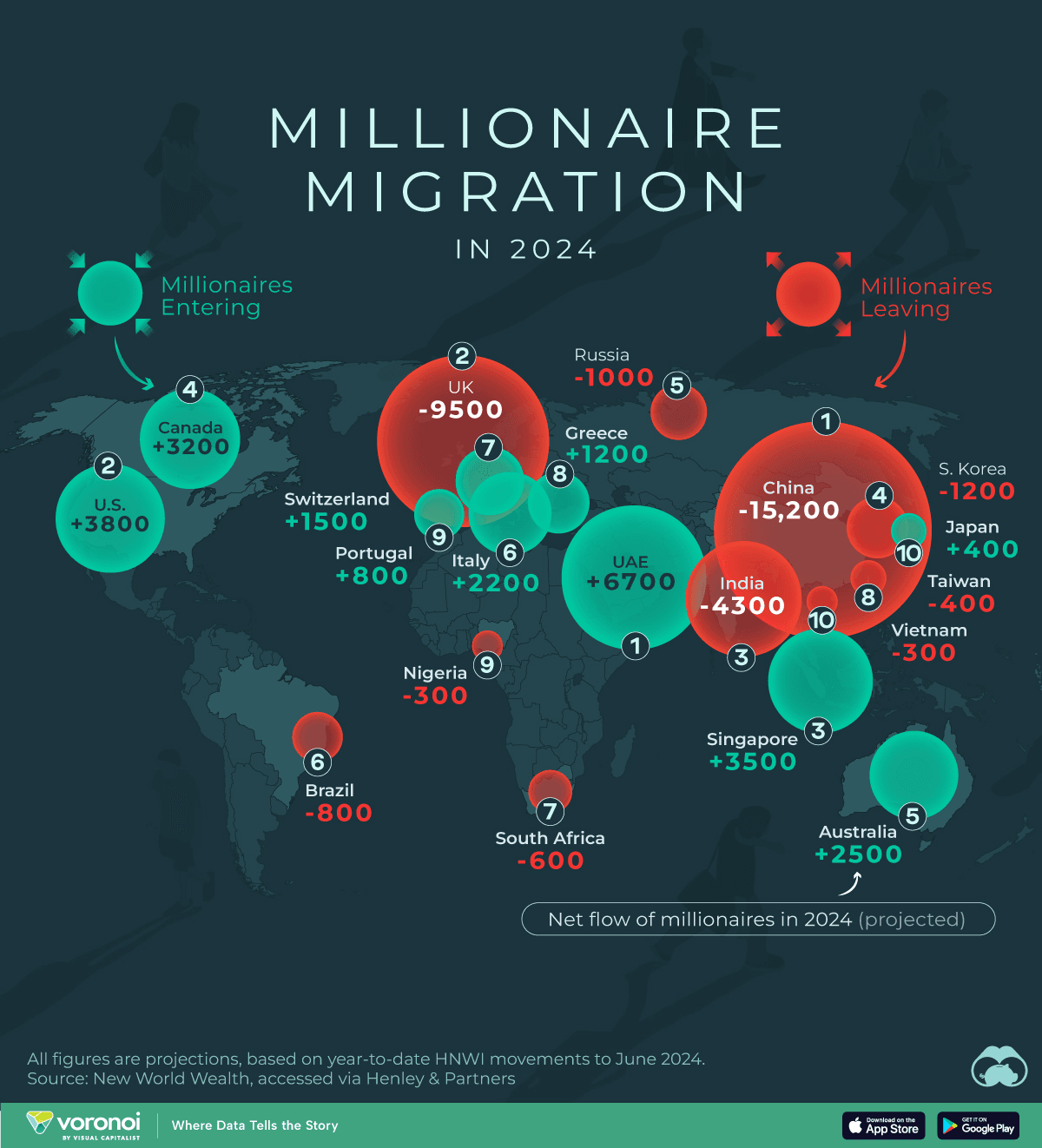
Chart: Visual Capitalist, based on projections from the Henley Private Wealth Migration Report 2024 (data: New World Wealth). Figures are projections, not measured outcomes.
What most of these families have in common is a priority to protect what they have built, which shapes how they invest and whom they trust. With that in mind, Vault surveyed high-net-worth individuals to understand how they view banks and wealth-management services in the UAE.
Key findings
1. Trust in UAE banks and wealth-management firms
62% of respondents said that they do not trust banks and wealth-management companies in the UAE. Two factors underlie this. 40% pointed to a lack of transparency around fees and charges, which they believe is driven by revenue goals rather than client interests. 50% expressed concern over the scandals and fraud cases they have seen in the sector.
2. Mis-selling
52% of respondents reported being pressured to buy whole-of-life insurance products, such as Zurich Futura and MetLife Future Protect, presented as investment opportunities. Respondents linked this to commission-based incentives for advisers, which can lead to sales that put the adviser’s earnings ahead of the client’s interests.
3. A preference for human advisers
90% of respondents said they prefer human advisers over robo-advisers. Personal judgement and the relationship itself remain highly valued, even as digital tools improve.
What fee transparency actually looks like
The 40% who distrust fees are reacting to something real: in a typical bank or brokerage relationship, the cost of advice is spread across several layers, and few clients see them added together. A transparent arrangement shows each of these in writing, in currency terms as well as percentages:
- Advice or management fee. What you pay the firm directly, and how it is calculated.
- Product costs. The ongoing charges of each fund or structured product, which are deducted inside the product and never appear on an invoice.
- Platform and custody fees. What it costs to hold the assets.
- Transaction costs and FX spreads. The margin on every trade and currency conversion, which can be material for a family moving money between dirhams, dollars, sterling and euros.
- Payments from product providers. Commissions, retrocessions or placement fees the firm receives for putting you into a product.
The last item is the one that matters most for trust. An adviser who is paid by the product provider has a reason to recommend products that pay well, whatever their merits. An adviser paid only by the client does not. Our fees page shows how Vault charges, and our guide to the difference between a broker and an adviser explains why the payment model shapes the advice.
How savings plans were sold, and what changed in 2020
Unit-linked and whole-of-life savings policies combine a small amount of life cover with a long-term investment account, usually funded by regular premiums over 10 to 25 years. Historically, much of the adviser’s commission on these policies was paid in the first year or two, and policyholders who stopped paying early often found that surrender charges consumed much of what they had put in. That structure rewards the sale rather than the outcome, which is consistent with what respondents described.
The UAE Insurance Authority responded with Board Decision No. 49 of 2019 on life insurance and family takaful, amended by Resolution No. 15 of 2020, which took effect in 2020. Insurance supervision now sits with the Central Bank of the UAE, which hosts the rules in its rulebook. The main provisions:
- Commission caps. For the savings element of a policy, total commission is capped at 4.5% of the annualised premium for each year of the policy term, and at 90% of the annualised premium overall. For pure protection, the caps are 10% a year and 160% overall.
- Commission spread over time. First-year commission is capped at 50% of the annualised premium or 50% of total commission, whichever is less. The remainder is paid in equal instalments over the remaining premium term, and first-year commission is subject to claw-back for at least five years.
- A free-look period. Policyholders have at least 30 calendar days to cancel, and the person who sold the policy may not ask them to explain why.
- Honest illustrations. Projections must be shown net of all charges, with at least two scenarios, and the maximum assumed gross return is capped at three-month EIBOR plus 4%.
- Warnings on thin protection. Savings products whose protection benefits are worth less than 10% of the premiums paid, in present-value terms, must carry a bold red warning that the product has limited or no protection benefit.
- Rebates belong to the client. Any rebate a company or distributor receives from a fund manager belongs to the policyholder.
An illustrative example. Take a savings policy with an annual premium of USD 24,000 and a 25-year term. The 4.5% annual rate would allow 112.5% of one year’s premium over the term, but the overall cap limits it to 90%, or USD 21,600 in total commission. First-year commission is then limited to USD 10,800 (half of the total), with the balance spread across the remaining 24 years. The rules reduce the incentive to sell and walk away. They do not make an unsuitable product suitable.
If you already hold one of these policies, the decision to keep, reduce or stop paying in depends on the surrender schedule, the charges and what you would do with the money instead. Ask for a current illustration in writing before deciding.
How to check a firm before you trust it
The 50% concerned about fraud have a practical defence: every legitimate firm sits on a public register, and checking takes a few minutes.
| Where the firm operates | Regulator | Public register |
|---|---|---|
| Abu Dhabi Global Market (ADGM) | Financial Services Regulatory Authority (FSRA) | FSRA public register |
| Dubai International Financial Centre (DIFC) | Dubai Financial Services Authority (DFSA) | DFSA public register |
| Onshore UAE, investment services | Capital Market Authority (formerly the Securities and Commodities Authority) | UAE CMA |
| Banks and insurers | Central Bank of the UAE | CBUAE |
When you search, confirm three things: that the legal entity on your contract is the one on the register, that its licence covers the activity you are paying for (advising is different from arranging, and both are different from managing money), and that the individual you deal with is authorised where the regulator requires it. Then ask the question in writing: how is this firm paid, by whom, and how much? A clear answer is a good sign. A vague one is not. For more on what to ask, see our page on choosing a financial advisor in Dubai.
Human advice, digital tools
The 90% preference for human advisers does not mean technology is unwelcome. It reflects where the value lies. A robo-adviser is good at the mechanical part of investing: building a diversified portfolio, rebalancing it and keeping costs low. It is less good at the decisions that matter most to a wealthy family: how much risk to take when a business sale is pending, how to fund school fees across three currencies, what to do when a parent dies or a child marries, or how to avoid selling at the bottom in a market fall.
The arrangement many families now look for combines both: digital tools for reporting, execution and cost control, with a qualified person accountable for the advice. What that judgement is worth, and how to tell whether you are getting it, is covered in what a financial advisor is actually worth.
Conclusion
Vault’s survey makes it clear: while HNWIs are drawn to the UAE for its stability and growth, trust in banks and wealth-management firms remains fragile. The causes respondents named, opaque fees, mis-selling and fraud, are each addressed by something a client can check: the payment model, the cost disclosure and the public register.
Trust is easier to verify than to assess. Our page on wealth management in the UAE sets out the regulatory checks you can run on any firm here, and choosing a financial advisor in Dubai covers the credentials and compensation questions to put to the individual. For readers whose scepticism is specifically about banks, the private banking alternative is an honest account of what an independent advisor does and does not replace.
Frequently asked questions
How many UAE HNW individuals distrust their banks?
62% of the high-net-worth respondents in Vault's survey said they do not trust banks and wealth-management firms in the UAE.What are the main reasons for the distrust?
Two factors dominate. 40% point to a lack of transparency around fees and the perception that those fees are driven by revenue targets rather than client interests. 50% cite the volume of scandals and fraud cases in the local financial sector.What is the most common mis-selling complaint?
52% of respondents reported being pressured to buy whole-of-life insurance products, with Zurich Futura and MetLife Future Protect the most frequently named, that were presented as investment vehicles. Long-term savings policies of this kind have historically paid much of their commission up front, which is the incentive the 2020 rules were designed to curb.What changed for life insurance savings plans in 2020?
The Insurance Authority's Decision No. 49 of 2019, as amended in 2020, capped total commission on the savings element of a policy at 90% of one year's annualised premium, limited first-year commission to 50% of the annualised premium or of total commission, whichever is less, required the rest to be paid evenly over the premium term, and introduced a free-look period of at least 30 calendar days.How do I check whether a firm is regulated?
Search the public register of the regulator the firm names: the FSRA for firms in ADGM, the DFSA for firms in DIFC, the Capital Market Authority (formerly the SCA) for onshore investment firms, and the Central Bank of the UAE for banks and insurers. Confirm that the licence covers the activity you are paying for, and that the entity on your contract is the entity on the register.Do HNW investors prefer robo-advisors or human advisors?
90% of respondents said they prefer human advisors over robo-advisors. The value placed on personalised judgement and human relationships remains high even as digital tools improve.
From Vault
The structural picture behind this piece — regulators, minimums and total cost — is set out on the service pages.
- Wealth management in the UAEThree regulators, no state pension, and what that changes about a plan built here.
- Wealth management in DubaiHow to tell the firms apart, and what the total cost actually comes to.
- Finding a financial advisor in DubaiCredentials, how the individual is paid, and what a first meeting should produce.
- Wealth management in Abu DhabiWhat changes when your advisor is regulated inside the same free zone as your structures.
Related reading
More on UAE & GCC
- InsightBest Financial Advisors in Dubai & the UAE (2026)How to choose a financial advisor in the UAE in 2026: regulators, fiduciary standards, fee structures, and the firms worth meeting before you sign anything.
- InsightBest Investment Apps & Platforms in Dubai & the UAE (2026)The best investing apps and platforms for UAE residents in 2026 — compared on fees, asset coverage, regulation, and who each one actually suits.
- InsightBest Wealth Management Companies in Dubai & the UAE (2026)A 2026 comparison of wealth management companies in Dubai and the UAE, and how to evaluate them on regulation, total cost, custody and fiduciary alignment.