
A financial plan is a roadmap from where you are today to where you want to be, and the route between them. It connects your income, savings, investments, protection and estate into one strategy, so that each decision supports the others. This guide sets out how to build one: the four steps every plan follows, the components it has to cover, why it has to be personal to you, and the gaps specific to living in the UAE.
Why so many people with wealth still lack a plan
Many affluent people have significant income, a diversified set of holdings and sophisticated banking relationships, yet no clear answer to three basic questions: When can I comfortably stop working? Am I saving enough, or more than I need to? How do my assets and income streams work together?
There are three common reasons. Income hides the gap: high earnings cover planning shortfalls until a specific event exposes them. Relationships start with products: many advisory conversations begin with something to buy, not a question about what you are trying to achieve. And planning is never urgent until it suddenly is.
What most people have instead is a collection of products: a savings account, an investment policy, some insurance, each bought at a different time for a different reason. Without a plan that integrates them, decisions become reactive. The practical costs are familiar: saving too little (or too much, and giving up life you could have afforded), leaving too much cash idle or too little accessible, missing opportunities in public or private markets, and delaying goals like retirement, education funding or a property purchase.
The four steps of a financial roadmap
1. Understand your starting position
Map everything: income and its stability, regular expenses, assets (cash, investments, property, business interests, end-of-service entitlements) and liabilities. Note which currency each sits in and which country it is exposed to. This is also where you establish your capacity for risk, which depends on your income security and time horizon, and is separate from your appetite for it.
2. Set specific goals
Goals need a cost, a date and a priority. “Retire comfortably” is a wish; “replace AED 60,000 a month of spending from age 55, in today’s money” is a goal you can plan against. Typical goals include retirement, children’s education, a home, a business venture and support for family. Ambition is good, but each goal has to be realistic against your cash flow, and relevant to the life you actually want.
3. Build a strategy that survives volatility
Match each goal to an investment approach suited to its time horizon. Money needed within two or three years belongs in cash or short-dated instruments. Long-dated goals can be invested in a globally diversified portfolio of equities and bonds, with alternatives where they fit. The strategy should set out how much to save each month, how to invest it, and how much liquidity to hold so that a market fall never forces you to sell at the wrong moment. Our investment options cover the building blocks.
4. Review it as life changes
A plan is a living document. Review it at least once a year and after any major event: marriage, a birth, a business sale, an inheritance, a change of residency. Rebalance to your target allocation on a rule set in advance, not when the news feels bad.
The components a complete plan covers
- Cash flow and saving. Knowing your surplus, and directing it deliberately, is the engine of everything else. An emergency fund of several months’ expenses comes first.
- Debt management. Prioritise expensive debt, and consider refinancing or consolidation where it lowers the rate. Mortgage decisions belong inside the plan, not beside it.
- Investment planning. A diversified, low-cost portfolio aligned with each goal’s horizon and your capacity for risk. Diversification across asset classes and countries is what stops any single shock from being catastrophic.
- Protection. Life and income-protection insurance where others depend on you. Insurance should protect; it is rarely the right vehicle for investing.
- Retirement planning. The longest-dated and usually largest goal. Starting early matters disproportionately because of compounding.
- Tax planning. Living in the UAE does not end your tax exposure: your nationality, home-country rules and where your assets are held all matter.
- Estate and succession planning. Without a registered will and a clear structure, assets can be frozen or distributed in ways you did not intend. For larger or more complex estates, family office structures bring governance to the same questions.
Why the plan has to be personal
A generic plan can be worse than none, because it provides comfort while missing the levers that would actually work for you. The dimensions that change the answer include:
| Dimension | Why it changes the plan |
|---|---|
| Residency and nationality | Determines home-country tax, reporting obligations and where you are likely to retire |
| Family structure | Dependants, education costs and succession needs shape both goals and protection |
| Business interests | Concentration in one company changes how the rest of the portfolio should be built |
| Time horizon | How long until each goal is needed decides how much risk it can carry |
| Liquidity needs | How much must stay accessible, and in which currency |
| Capacity for risk | How large a fall you can absorb without changing your plans |
Consider an illustrative example. A 35-year-old entrepreneur in Dubai tracks his income and spending and finds a meaningful monthly surplus. He wants at least 30% of his investments to remain liquid in case the business needs capital. A personalised plan would keep that liquid portion in cash and short-dated bonds, invest the long-term portion in global equities for growth, and consider a modest allocation to alternatives such as real estate or gold. A colleague with the same income but no business, and children approaching university, would get a different plan, because her goals, liquidity needs and time horizons are different.
The UAE-specific layers most plans miss
No personal income tax means more of what you earn is retained, which makes the savings decision more powerful. But it also means less structure is imposed on you: nothing nudges you into a pension.
Expatriates have no state pension. The End-of-Service Gratuity is a lump sum tied to salary and years of service, and it was not designed to fund decades of retirement. Our guide to planning for retirement without a pension and our analysis of whether to take the gratuity as a lump sum or invest it cover this in detail.
Cross-border complexity is the norm. Most residents will eventually move, retire elsewhere, or have family and assets in more than one country. Holding assets in your own name with a global custodian keeps them portable.
The decision window is compressed. Residency is tied to employment or a visa, so many people effectively plan in multi-year chapters. A good plan anticipates the next chapter rather than assuming you will stay put.
Turning the plan into action
The point of a plan is to change what happens to your money. Technology helps: inside the Vault app, Vault Plan lets you set goals (retirement, education, property), map your current assets and income, and see a goal success score that updates as your savings and priorities change. Because planning, saving through SmartCash and investing sit in one place, strategy and execution do not drift apart.
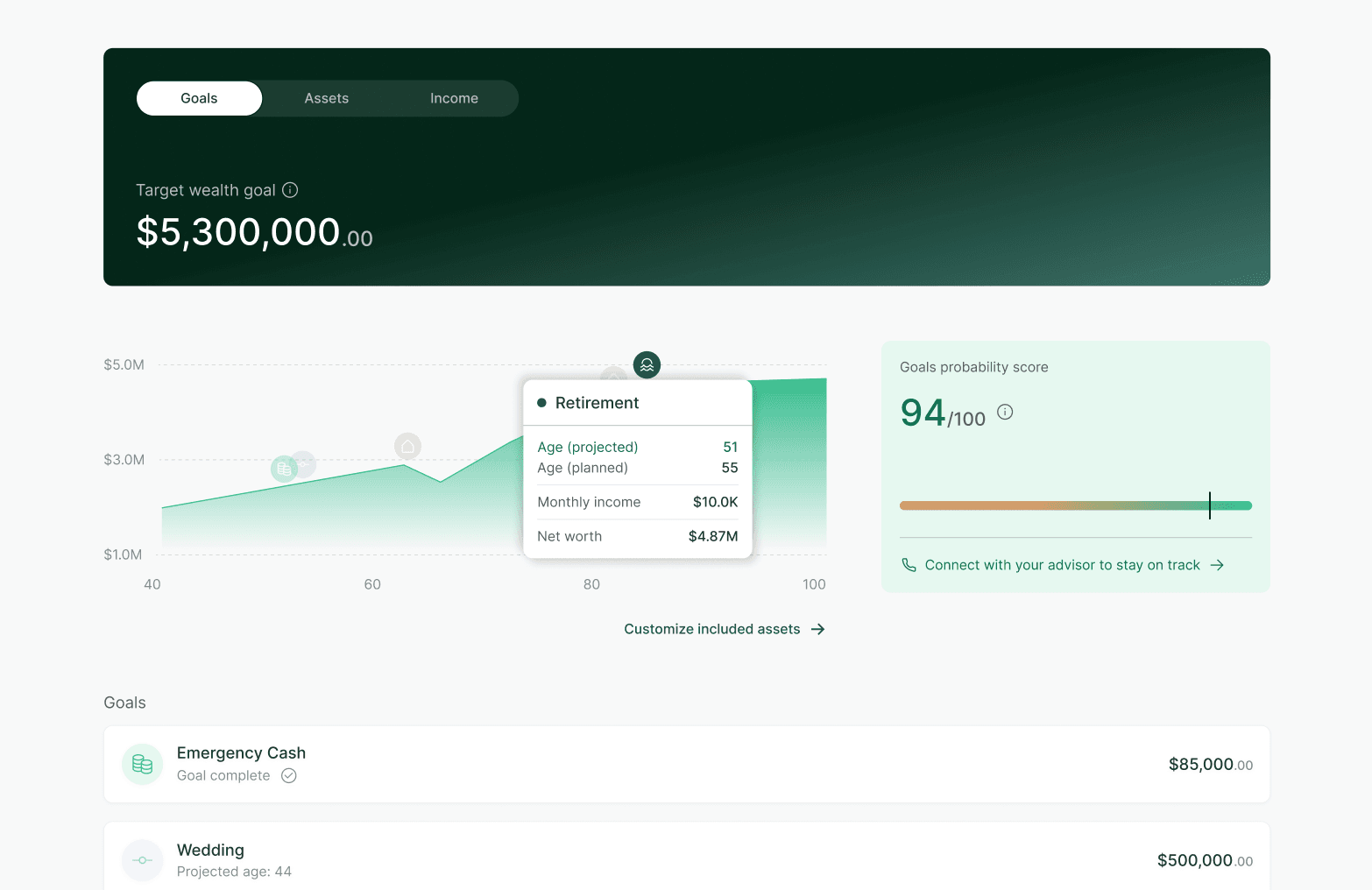
Vault Plan: goals, projected net worth and a goals probability score in one view.
Where the picture is cross-border, involves a business or family structure, or you simply want a second pair of eyes, a financial planning conversation with a fiduciary advisor is the faster route. It is worth understanding what good advice is actually worth before you choose one.
The enduring value of a plan
Financial planning is a process, not a one-off event. It asks for commitment and regular review, and in return it replaces guesswork with a clear route from where you are to where you want to be. Start early, keep it specific to your life, and revisit it every time that life changes.
Frequently asked questions
What is financial planning, in plain English?
Financial planning is the process of connecting your current financial situation to your future goals through a deliberate strategy. It covers cash flow, savings, investments, insurance, tax, succession and major life events, considered together rather than in isolation. The output is a written roadmap that gets reviewed as circumstances change.What's the difference between a financial plan and a budget?
A budget controls month-to-month spending. A financial plan sits above it: what you are saving for, how much you need to save, how that money should be invested, how to protect against the unexpected, and how to pass wealth on. Budgeting is tactical; planning is strategic.What's the difference between having products and having a plan?
Products are isolated; a plan integrates. A savings account, two investment policies, an insurance contract and a brokerage account are a collection of decisions made at different times for different reasons. A plan states the goals, identifies the gaps, and uses products as tools to close them.What makes a financial plan personalised?
It is built around the dimensions that change the answer for you: residency and home-country tax, family structure and dependants, business interests, time horizon, liquidity needs and capacity for risk. Someone with US tax exposure and someone with none should not hold the same structure, even with identical goals.When should I start, and how often should I review it?
Start as soon as your financial life has more than one moving part, because compounding rewards early action. Review at least annually, and after any major event: marriage, a birth, a business sale, an inheritance or a change of residency.What's the most common planning mistake UAE residents make?
Treating the End-of-Service Gratuity as a retirement plan. It was never designed to fund a 20 to 30 year retirement, and inflation erodes its real value. The fix is a parallel investment strategy alongside whatever your employer provides: globally diversified, long horizon, low cost.Do I need an advisor to build a plan?
Not strictly: disciplined investors can do much of it themselves. The case for an advisor strengthens when the picture becomes cross-border, when family or business complexity enters, or when you suspect you will make emotional decisions at the wrong moment. Ask for a planning conversation, not a product pitch: a good advisor spends the first meeting on discovery.
From Vault
Turning this into an actual plan is what the planning process is for.
- Financial planningGoals with figures and dates attached, and a plan revised as things change.
- Family office servicesCurated investor policy statements and multi-entity structuring from USD 5 million.
- Wealth management in the UAEThree regulators, no state pension, and what that changes about a plan built here.
Related reading
More on Wealth planning
- Insight5 Questions to Ask When Someone Promises 'Guaranteed' Returns: A Guide for UAE InvestorsNo return is truly guaranteed. Five questions to put to anyone promising one, the leverage and fine print that usually sit behind the word, and the cases where the guarantee failed.
- InsightBespoke, Not Box-Ticked: How Personalized Wealth Management Works in DubaiStop fitting into pre-packaged portfolios. Learn how Dubai’s top wealth firms craft specialized strategies for cross-border needs and business exits.
- InsightDEWS Explained: The DIFC Employee Workplace Savings PlanA guide to DIFC Employee Workplace Savings (DEWS), the scheme that replaced the end-of-service gratuity in DIFC from February 2020: who is covered, what employers pay, how the money is invested and what it costs, how pre-2020 gratuity is treated, and what to do with the balance when you leave.